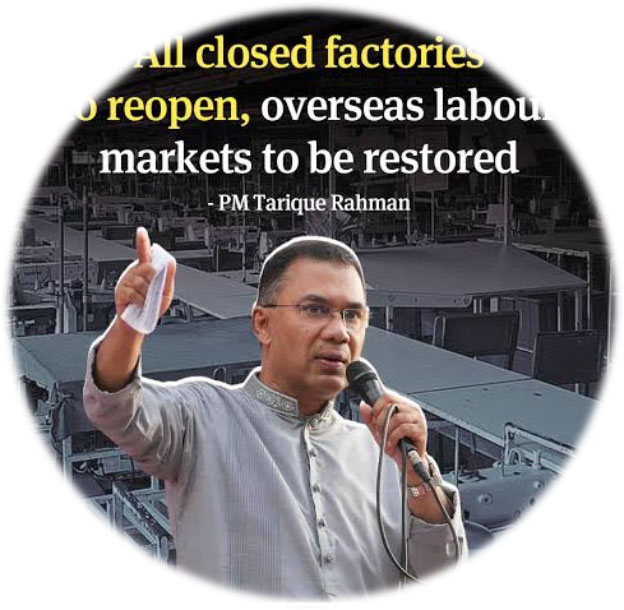
Dhaka: Two years ago in Bangladesh, students led a movement that removed Sheikh Hasina from power. At that time, the country’s economy was doing well and people had jobs. Then the students decided to create a new Bangladesh and, through terrible violence, looting, and chaos, drove Prime Minister Sheikh Hasina out of the country. After that, Muhammad Yunus came, showed people the vegetable gardens, and later Tarique Rahman’s government took over. But in these two to two-and-a-half years, Bangladesh’s economy has deteriorated so much that over a million garment workers are now taking to the streets in violent protests.
In Bangladesh, 529 garment factories are closed and there is huge dissatisfaction among more than a million workers. This information has been provided by the Bangladesh Garment Manufacturers and Exporters Association.
Thousands of workers have taken to the streets demanding wages. In many places, the protests have turned violent. Violent demonstrations are happening in major industrial centers like Dhaka, Gazipur, and Ashulia.
There has been a huge increase in the inflation rate in the country. Workers are demanding that their monthly income be raised from 12,500 Taka to 30,000 Taka. The government has hurriedly set up a ‘wage board’.
Garment factories are the backbone of Bangladesh’s economy and contribute more than 80 percent to the country’s total exports. The IMF’s projection for Bangladesh’s growth is the lowest in the past 40 years. The country’s growth rate is expected to be between 2.2 percent and 3.6 percent.
How bad has the situation in Bangladesh gotten?
Over 500 ready-made garment factories in several industrial areas of Bangladesh have shut down. Thousands of workers from hundreds of other factories have taken to the streets. Violent clashes are happening between the police and workers in Dhaka, Gazipur, and Savar areas. There are incidents of arson on the streets. Due to the violent clashes, traffic on major highways has come to a halt and factory operations have stopped. The protesting workers have set fire to police stations, police vehicles, fire department vehicles, a jute warehouse, and a bank.
Gazipur and Mymensingh are the most affected areas where 276 factories have been closed. In addition, operations in 185 factories in Savar, Ashulia, and Zirabo have been halted. Even in areas under Dhaka Metropolitan Police, 68 factories are closed.
On Sunday, Tariq Rahman’s government formed a six-member wage board for garment workers, but the protests are still ongoing. The police are swinging batons to control the protesters, tear gas shells have been fired to disperse the crowd, water cannons are being used, and the police have also thrown sound grenades. To maintain law and order, five platoons of the ‘Border Guard Bangladesh’ have been deployed in the affected industrial areas.