







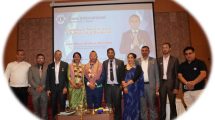
Kathmandu. Kathmandu Metropolitan City mayor Balendra Sah (Balen) says that the public transport system of Kathmandu should be made reliable for road safety and for this, all parties’ responsibilities should be fulfilled. Inaugurating the workshop organized by the Road Safety Council, Road Safety Society, and Rotary Club of Darbarmarg in collaboration with Kathmandu Metropolis, Mayor Sah said, ‘2000 vehicles ply on Kathmandu’s ring road, which is reached by 200 public vehicles. The more passengers can be accommodated, the more income is earned.
Therefore, there was unhealthy competition between the public transport operators. This situation is also one of the causes of road insecurity. It should be created through pick and drop which does not affect the income no matter how many passengers are carried. If that can be done, the speed of vehicles running at uncontrolled speed will be controlled and accidents will be reduced. Mayor Sah said, “Since there is no trust in public transport, all the consumers have to buy the vehicle.” After everyone bought their own vehicle, the pressure was high. Another challenge of traffic management is this kind of pressure. This pressure can be reduced after increasing confidence in the public transport system.
The Kathmandu Valley Public Transport Authority Act, issued for the operation and management of public transport in Kathmandu, will create an effective working environment for road safety. Mayor Sah says. The workshop was conducted with the support of the National Disaster Risk Reduction and Management Authority, the World Health Organization Nepal, Nepal Injury Research Nepal, and Nepal Disaster and Emergency Medicine Center.
Speaking at the workshop, Secretary of the Ministry of Physical Infrastructure and Transport, Gopal Prasad Sigdel, said that it is now necessary to work towards reducing road accidents, injuries, and deaths. “Road safety can be increased through engineering (road construction), enforcement (road operation and traffic management), and education (awareness programs).” Sigdel said, “Currently, work is being done on some legal arrangements including road classification, and national transport policy.” This clarifies the requirements and the jurisdiction of the concerned office. Because the area and authority are divided for the same work, it is now difficult to work effectively.
The first cause of human death in Nepal is non-communicable diseases. The second is a communicable disease and the third is the problem caused by injuries.” Joint secretary of the Ministry of Health and Population Dr. Krishna Paudel said, ‘Injuries are a serious matter from the point of view of public health. In spite of this, integrated work has not been done to reduce accidents.” He quoted the statistics of Nepal Police for 2077-078 and said, ‘2 thousand 872 people died in road accidents this year. 7 thousand 282 people were seriously injured. 25 thousand people were injured. This is not an ordinary problem.
According to statistics, 9.4 percent of every 100,000 people in Nepal have been injured by accident. About 3,000 people lose their lives every year and about 6,000 people are facing injuries of a serious nature. It is a statistic that every 24 seconds in the world, 1 person dies due to a road accident. World Health Organization Nepal is working to reduce this kind of damage. Gambo Sherpa, a representative of the organization in the workshop, mentioned that they are in a coordinating role through policy and awareness programs.
In the workshop, there will be presentations and group discussions on the state of national road safety and the decade action plan, road accidents, search and rescue challenges, government efforts to reduce disaster damage, and pre-hospital, hospital, and post-hospital and public health disaster preparedness. Before this, 40 firefighters and observers from the municipalities of Kathmandu Valley have been trained on this matter. The training was provided by Rowat Writtles and Johnson Snowham from the Greater Manchester Fire and Rescue Service in the UK.
The training included topics such as accident and humanitarian angle, arriving at the scene and analyzing the situation, the condition of the vehicle and how to locate it, management of physical means and equipment for search and rescue, reducing or eliminating other risks, ending the rescue work, etc. During the training, experimental classes were conducted for practical skills along with theoretical knowledge. Among road users, pedestrians, cyclists and motorcyclists are the most vulnerable to road accidents. The sustainable development goal to be achieved by the year 2030 is to reduce road accidents by half.



Add Comment