






Kathmandu. Nepali Congress President Gagan Kumar Thapa has expressed the view that it is essential to protect and promote the press because any problems faced by independent media would directly affect the democratic system.
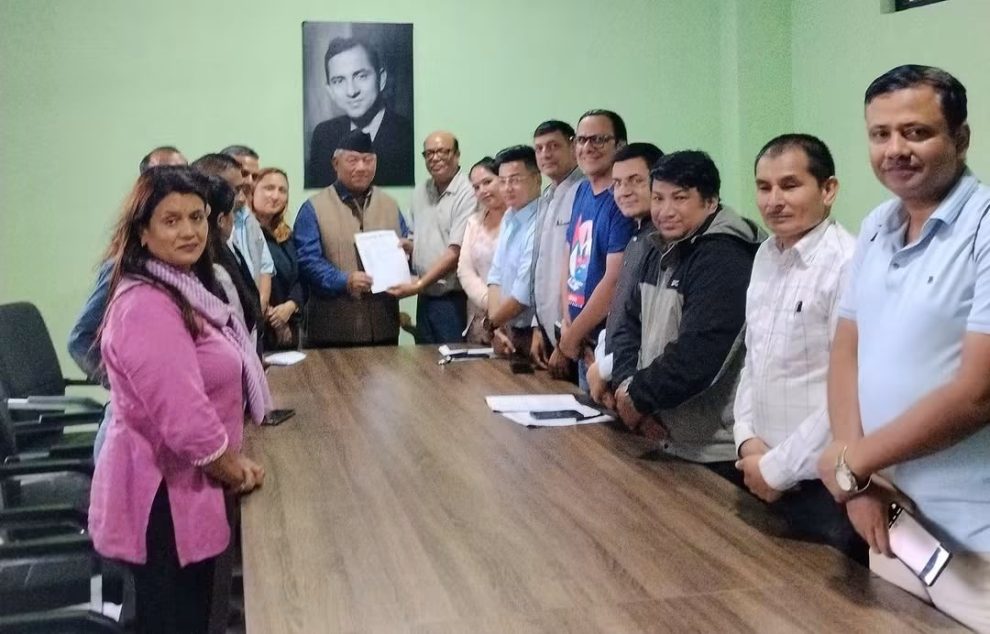
President Thapa shared this opinion while receiving a letter of concern recently submitted by the ‘Print Media Rescue Suggestion Task Force’ formed by the Kathmandu branch of the Federation of Nepali Journalists, regarding issues such as cuts in funds for public welfare advertisements, policy arrangements related to advertisements, and challenges faced by print media.
While addressing the team led by coordinator Damodar Prasad Dawadi that arrived at the party headquarters in Sanepa, President Thapa expressed that any crackdown on the independent press is a crucial issue for democracy for his party, even though it might be a professional concern for journalists. Emphasizing that he takes the issues raised by journalists and media seriously, he said that while this might be about your professional problems, for Congress, it is a matter connected to democratic prestige. He mentioned that since the press is a pillar of democracy, protecting it is a key responsibility of a democratic party.
Thapa said that the problems of the print media should not be seen just as issues related to the journalist profession but should be viewed as connected to the fundamental aspects of democracy. He said that the contribution of print media was very important in the restoration of democracy – ‘We should not forget that when there are problems for the press, it affects the entire democratic system.’
In line with this, Nepali Congress parliamentary party leader Bhishmaraj Aangdembe expressed the commitment to push issues of press and freedom of expression as an important agenda of the party. He said that any situation that weakens the media or puts the journalism sector in crisis will also weaken democratic practices, so the party will take a serious stance on this issue.
In the discussion, which was attended by various print and online media editors and publishers, along with Nepali Congress parliamentary party coordinator Niskal Rai, the coordinator Dawadi, central member of Nepal Journalists Federation Surya Subedi, Kathmandu branch president Shobha Aryal, secretary Ramesh Kumar Bohora, and task force members Mukti Bastola, Hem Silwal, and Tank Karki, pointed out that recent cuts in welfare advertisements provided by the state and new policy arrangements related to advertising have put print media, especially small investment and self-employment oriented ones, in more trouble. They said these policy arrangements have created a situation where the continuity of financially weaker media is in question.
The task force has been demanding that the government immediately implement the rules that were recently amended to cut the amount for public welfare advertisements and to stop giving government ads to private media, since even though the Supreme Court has already annulled the government’s decision, it has not yet been enforced.
Meanwhile, the meeting of the Nepali Congress Central Executive Committee concluded that the press and media are the pillars of democracy and an important means to hold the state accountable to its citizens, and therefore, any policy that discourages or weakens the media would not be in the interest of democracy and press freedom.
The meeting has urged the government to immediately review the decisions affecting private sector media and the changes made to the procedures concerning public welfare advertisements. The Congress has asked the government to address the legitimate demands of the media sector and manage the distribution system of government advertisements in a transparent, fair way that treats all media equally. Congress believes that if there is any kind of discrimination or a policy to exclude certain media in the distribution of government advertisements, it could negatively impact the development of a free press and democratic practice.




Add Comment