






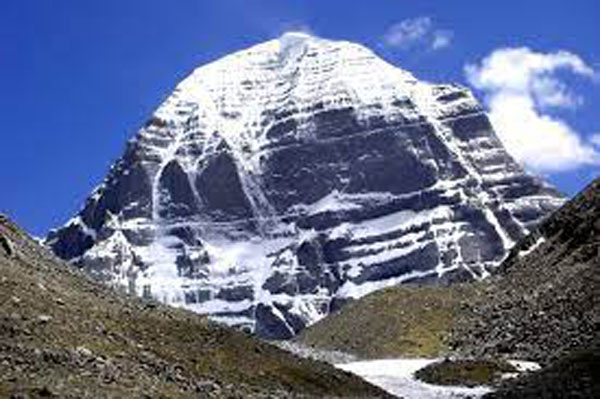
While the height of Kailash is about 2000 meters less than Mount Everest, but still no one has been able to climb it. Yes, some people have been successful in orbiting it for 52 km. Actually, the angle of Mount Kailash is more than a touching degree. Whereas, the angle of Mount Everest is 40-50 degrees. That’s why climbing Kailash is difficult. There have been many attempts to climb it. The last attempt was made in 2001.
However, now climbing Kailash is completely banned. Mount Kailash is unshakable since the time of the creation of the universe. Different religions have different beliefs about this mountain, but according to Hindu scriptures, this mountain is the abode of Lord Shiva and Parvati. stream of supernatural power around the mountain
All three religions Hindu, Buddhist, and Jain consider Kailash sacred and mysterious. The teachers of Tibetan monasteries believe that a stream of supernatural power keeps flowing around Mount Kailash. As soon as you reach it, you start experiencing supernatural flow in your brain.
Due to supernatural mental power, it is not possible to reach the top of Kailash. The second reason is the 65-degree angle of the mountain and the third important thing is that snow freezes and melts around the mountain, but snow remains frozen throughout the year on the peak. This too is an unsolved mystery.
Mount Kailash is not affected by any weather
There are three parts of Tibet. East Tibet, West Tibet, and Central Tibet. Central Tibet can also be called North and South Tibet. Kailash and Mansarovar are located in western Tibet. The height of Kailash peak is about 6714 meters. The mountains around Kailash are made of red, and brown soil and raw stones.
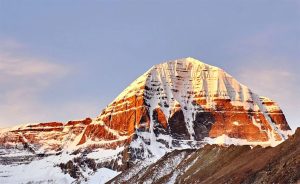
The surprising thing is that even in the midst of such dusty raw mountains, Mount Kailash is completely made of granite stones. Due to wind, snow, and rain, the shape and color of the mountains around it keep changing, but Mount Kailash is not affected by the weather.
Mount Kailash is always covered with snow. Kailash, which looks like a grand pyramid from a distance, is a self-manifested Shivling. When seen from the sky, 16 small and big mountains are visible around Kailash, whose color is yellow. It looks like a Shivling is placed on a plate amidst lotuses with sixteen petals.
Mansarovar is called ‘Maham Yutso’ in the Tibetan language. Geographically, it is at an altitude of four and a half thousand meters above sea level. Right next to Mansarovar are the Rakshastal and Mansarovar lakes. The surface of Rakshastal is below Mansarovar lake.
When the Mansarovar lake overflows, a river named Gangachhu fills the Rakshastal with this water. As if Mansarovar is trying to purify the Rakshasa Tal with its holy water. It is believed that when Ravana did penance here, he made this pool for bathing. Because of this, it was named Rakshastal.
The mythological importance of this place is amazing.
In ancient times, Saptarishis and Sankadikas did penance here. Lord Dattatreya did penance here in Satyuga. Ravana had reached here in Treta Yug and Pandavas had reached here in Dwapar Yug. After this, Tathagat had done penance here in Kaliyuga. In this way, Kailash has been of great importance in all four ages.
Adi Shankaracharya and Sikh Guru Nanak Dev also reached here. Sanatan Hindu religion considers Kailash as the form of Shiva. In Buddhism, Kailash is considered to be the form of Shakyamuni Buddha. Lord Buddha resides here with five hundred Bodhisattvas. This place has special importance in Jainism also. In Jainism, the mountain near Kailash is called Ashtapad. It is also said that the first Tirthankar Rishabhdev attained Nirvana here. After that, his son Raja Bharat got Ratnamaya Singh Nishidha Prasad done here in his memory.
Mansarovar is mentioned in Buddhist literature as ‘Anavattap’. According to Buddhist tradition, the place of Kailash is in the center of the earth. The presiding deity here is Dev Dharampal (Demchok). He wears the skin of a tiger, wears a garland of heads. He has Damru and Trishul in his hands and Vajra is considered his power.
Parikrama of Kailash 52 km
The Kailash mountain range extends from Kashmir to Bhutan. This mountain is situated between Lha Chu and Zhong Chu. There are two connected peaks here. Out of this, the northern peak is known as Kailash. The shape of this peak is like a huge Shivling. Its circumambulation has great importance in Hinduism. The circumambulation is six km.
The people of Tibet believe that they should do 3 or 13 parikramas on this mountain. On the other hand, many pilgrims of Tibet complete its circumambulation while offering obeisances. They believe that one parikrama removes the sins of one birth, while ten parikramas remove the sins of many incarnations. The one who completes the Gand Parikrama gets freedom from birth and death.
Part of India, but now occupied by China
When there was a war between India and China in 1962, China captured India’s Kailash and Mansarovar. Now to reach here one has to obtain a Chinese tourist visa. Due to this, it is not easy to go to Kailash. Mansarovar is reached after 50 types of checking by Kshatya’s jawans and Chinese soldiers.
The Kailash Mansarovar Yatra lasts two to three weeks (depending on where you start the journey.) The Government of India has made ‘Lipulekh Marg’ to make this journey easier. Defense Minister Rajnath Singh inaugurated this route on 8 May 2020.
Although the pilgrims of Kailash are happy with this, there are still many hurdles in it. Apart from this, special permission has to be obtained from the Government of Tibet to enter this area.
Only Indians can go through Lipulekh
The Lipulekh route, 750 km northeast of Delhi, reduces the travel time to six days. There are other complications associated with the script as well. As this route is only for Indian pilgrims. Apart from this, only 1000 pilgrims are allowed to go through this route.
Another option for travel is the Simikot, Korala, Kerung, and Kodri border points of Nepal. There is no limit to the number of devotees passing through here. However, this is also possible only according to the limit set by China.
Whereas, the third option is to pass through Nathula Pass from Gangtok via Sikkim. There is a huge crowd of devotees from June to the end of July in Kailash Mansarovar, located in the Burung province of Tibet’s Nagri region, Uttarakhand in North India, and the Far West Province of Nepal.
Only lucky ones can complete the journey
After reaching Tibet from Lipulekh or Simikot in Nepal, pilgrims have to travel 150 kilometers to the northern part of Tibet. Apart from walking on the steep hills, the devotees also have to face the changing weather here every moment. People who become unwell quickly due to weather changes, also need oxygen. After the coronavirus, people still need to be more careful, because there are not enough medical facilities available in small areas of Tibet.
What did author Kalin Thubron write?
British author, traveler, and novelist Colin Thubron wrote the book ‘To a Mountain in Tibet’ in 2011. In it, he has written in detail about his experiences in Tibet and Kailash Mansarovar. He wrote – I believe that Mount Kailash is the mysterious heart of the universe. Terrible loneliness is felt on the way to Kailash.
Although Hindus reach here with faith, the British come only as tourists. I have seen that it takes several days for pilgrims from India to reach Tibet. There is a government medical examination on the way. Lungs-heart etc. is examined. Half of the devotees are turned back because of this. Even those who get permission, many of them fall ill while reaching the height of 17,000 feet and then they have to return disappointed. In this way, those who complete the journey of Kailash Mansarovar can be called lucky.




Add Comment