






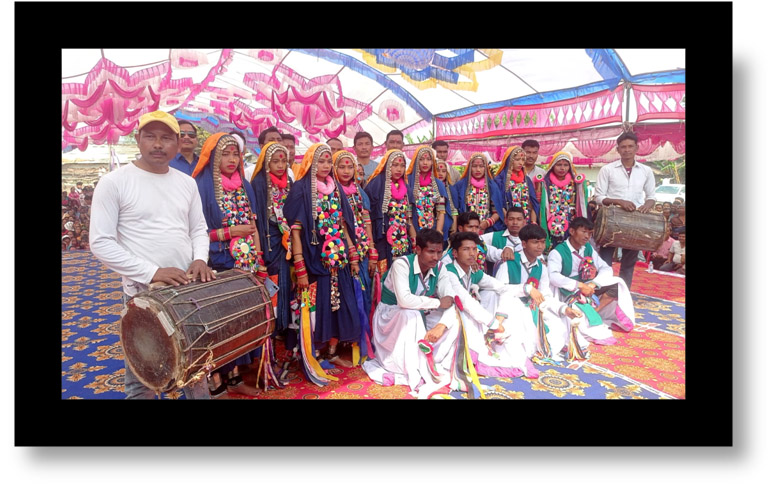
Hori festival is celebrated as the biggest festival of the Ranatharu community. This festival is so big that it starts from the arrival of Hori on the full moon of Magha and lasts till the departure of Hori on the day of Chait. Meanwhile, from the Hori establishment to Khakdehra, young people play Hori for thirty-eight days. On the full moon of Hori Magh, Hori installation, burning of Hori on Phagu Purnima, Hori Puja, Phagoha, and Hatkana of Phagu, concluding with Khakdehra and farewell to Hori on Chaitra are celebrated. These festivals and rituals are interrelated with each other and in the Ranatharu community, this festival lasts for a long time, so it is considered as the biggest festival.
Myths and Superstitions
In the Ranatharu community, the tradition of believing in Hori has existed since ancient times. It is connected with mythological events related to the Hindu religion. In particular, according to two mythological contexts in Hori, Hiranyakashyap’s son Prahlad (Prahlad) was a great devotee of Vishnu, but Hiranyakashyap himself considered himself as God. He wanted my son to sing my praises, and worship me, but Prahlad used to praise Vishnu and worship him. Hiranyakashyap, who could not see this, tried various methods to kill Pirad but failed.
One day he sent his own daughter Holika to kill Vishnu devotee Phirada. Halika, who has been given the boon of not dying from fire, takes her nephew in her arms and sits in the fire on the full moon day of Fagu Purnima, because of the coolness of the fire, she survives first. But Holika burned to death in the same fire and from that day every year on the day of Fagu Purnima, Holika was burnt in the evening and the same was lit in the morning.
According to another incident, during the Dwapara Yuga, Lord Krishna played Holi colorfully with the Gopanis from Mathura to Gokul on the day of Phagu Purnima. From that day onwards, Holi started to be celebrated without stopping on the full moon. Thus, it is found that there is a popular belief that Hori came from Mathura in every house.
No matter how powerful a lie is, one day it will surely lose in front of the truth. There is also a popular belief that Hori is played on Phagu Purnima, burning mutual incense along with Holika to establish harmony, love support, and trust.
Establishment of Hori
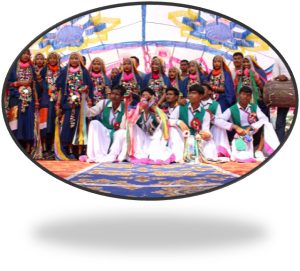
On the day of Magha Purnima, Hori is installed in the vicinity of the temple of the village deity by offering Kanda, wood, tea tree, sweetmeats, and, offerings. Zinda Hori starts playing from that day.
Hori Dahan
On any other day except Tuesday, hori is burnt in the evening or in the morning. To burn Hori, a male person goes to the place where Hori is established, and the servant or Bhalmansa collects gifts (worship material) from house to house and worships and burns the effigy of Hori. After that, they make loud noises saying, “There is a fire in Hori, there is a fire in Hori”. After making a fire, the same fire runs in one breath and puts it in the well or tap hole of Padhana. Minister Rana of Gadaria says, “In the past, a live chick was also burnt while burning Hori, but nowadays betel nut is offered instead of blood.” Sweets and puris taken for worship are shared and eaten there but not taken back.
Hori’s Commentary
Tika is done on the next day of Hori Dahan. After going to the place where Hori was burnt, someone put a leaf on it and put it on their foreheads and exchanged the Hori greetings. Boys play as matbaria and girls play hori for some time after tika there. Then they come to the house of Padhana or Bhalmansa and play hori singing songs along the way.
Long live and long dead
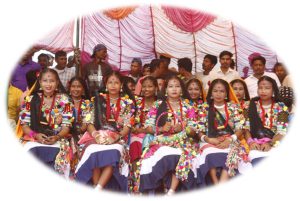
From the installation of Hori until Hori Dahan, after having dinner in the evening, young people sing songs and play Hori in Danka Lake, which is called Zinda Hori, while the Hori played from the day of Hori Dahan to Khakdehra is called Mari Hori. Various types of Hori are played in Hori, singing songs based on the story of Ramayana, Mahabharata, Thadauwan Hori, Matbaria Hori, Lohkauwan Hori, Sada Hori, Badhai Hori, Khichadi Hori, Gadwali Hori.
Worship in Hori
Worship in Hori is done according to their respective deities. This is the worship of the Kuladeva. According to the clan, the worship is different and this worship is not in everyone’s house. Only he whose deity receives this pooja is worshipped. According to Kuldevata, some people do Hori Poojan while they are still alive (since Hori is established) and some do Hori Poojan when they are dead. In the pooja, Puri Joda made by adding sugar, ghee, and water is used for agiari, but in someone’s house, if there is no god in their house, i.e. those who are Sarkar Bhagat, they do not do this pooja.
Khakdehra
Khakdehra festival is celebrated on the eighth day of Hori Dahan, even if it falls on the sixth day of the week. On the day of Khakdehra, around five o’clock in the morning, seven balls of raw clay (Matengra) are taken in each sink. Three lamps made of clay are made and seven types of naj (such as gram, banana, mustard, lentils etc.) are kept in one lamp. Cotton is placed in the second lamp and the lamp is lit in the third. A bit of sitabanni (sinka chucho) is kept and a khapteroma (a part of broken gagro) is kept and a bucket of water is taken along with it.
The padhana of the village or the big man of the village, who has been plowing the khakdehra since ancient times, comes from a home with the parihari (lower part of the plough), ghee. Those who go to break, someone from their house takes the same khaptora with the lamp and goes outside the village to the south of the village saying ‘Abo ri andhari dhundri langdi luli’. The elders of the village make them keep it in one place like a house-to-house puja and everyone keeps it there and goes away. Asami doesn’t look back when one of the main men starts cracking up, and that’s where Hori’s farewell comes from.
Ancestors say that on the day of Khakdehra, the one who gets happiness in his house, such as a baby is born in the house, a buffalo is born, that means it is good, he starts breaking Khakdehra from that day. And, on the day of Khakdehra, in whose house a bad incident happens, they stop breaking Khakdehra from that day. Not everyone breaks the bank.
Fagoha and Hatakana
Fagoha has a special significance in February. In Fagu there is a tradition of asking for fagoha and giving fagoha. Fagoha operates in two ways. It is customary to ask for and give fagoha from the first Hori Dahandei to Khakdehra. Hori-playing girls go to the houses of Bhalmansa, Pradhan, Padhana, and Chakar villagers in the morning and ask for fagoha and after evening they play Hori.
It is found that cousins, Nanduiya and Mit Parne in the second relationship go to give fagoha to their sisters-in-law, Thakurain, Sarhaj, Sainar especially from the day of Hori Dahan. In the same way, hatakana is also very important for mutual intimacy and camaraderie.
It is bad for guests to make arrangements for food at their house, saying that there is food at my house today. Especially on Hori, relatives are invited to their homes and welcomed with sweet food. It is believed that the one who has given the fagoha, it is obligatory for him to do otherwise, otherwise it will be a sin. Nowadays, there seems to be some decrease in the tradition of giving fagoha and feeding hatkana.
Hori bidae (Goodbye Hori)
Farewell to Hori is done in the pasture of Chait. Grazing is the worship of the village. On that day, every household in the village cooks delicious rice and other vegetables with special fish and goes outside the village and stays there for the whole day. In the evening, after the village Bharra or Guruwa has performed the puja, everyone plays Hori and sends Hori outside the village singing the song ‘Aaj Hori Gayi Re Balamu Pardesh’. From that day Hori goes to Mathura again. In this way, the year can be counted.



Add Comment