






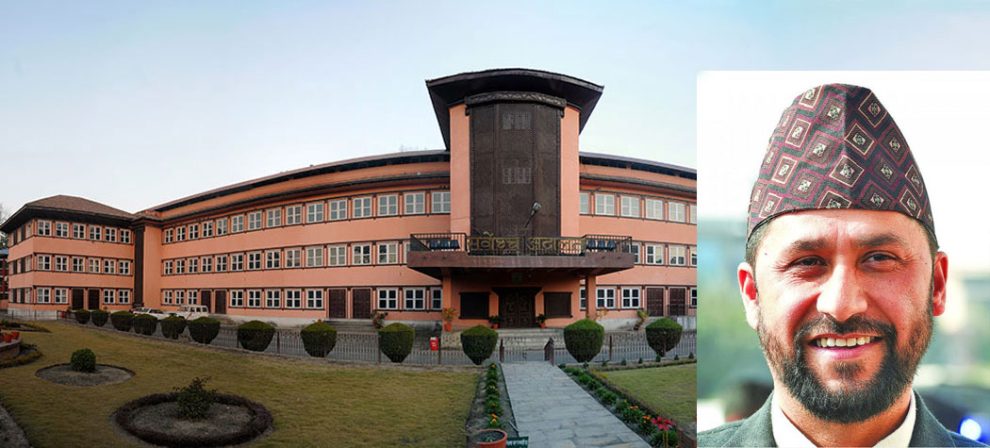
Kathmandu. With the revocation of citizenship of Home Minister Ravi Lamichhane, MP and party president positions have been lost. The constitutional bench of the Supreme Court gave this verdict after the debate on the case related to Lamichhane’s citizenship was over on Friday.
Earlier, advocates Ashish Adhikari, Sudigya Pant, Yagyamani Neupane, and Sasikumar Pokharel argued on behalf of Lamichhane along with senior advocate Narendra KC. After the arguments of the lawyers for Lamichhane were over, the lawyers of the writ petitioner made a counterargument. Senior advocate Surendra Bhandari argued that the constitutional bench is the one who will see who is ineligible and who can be in the federal parliament. Lamichhane said that Nepali citizenship was revoked after taking American citizenship, so he had to go through the process to get citizenship again. Lamichhane presented the argument that although he had informed the Nepali state that he was going to renounce his American citizenship, he had not informed the state that he had renounced his American citizenship.
A writ was filed against Lamichhane on the 28th of November to prevent him from taking oath as a member of the House of Representatives. But after the constitutional bench sitting on December 6 did not issue an interim order in the case of Lamichhane’s citizenship and passport dispute, the way to take the oath was opened. The investigation was started after Lamichhane was accused of not revoking his Nepali citizenship when he took his American citizenship, and even after renouncing his American citizenship, he used his old citizenship again.
The Supreme Court has ruled that all decisions since his candidacy will be null and void while giving a verdict on Lamichhane’s citizenship case. “since the respondent Ravi Lamichhane has not completed the process of legally re-establishing his Nepali citizenship after renouncing his American citizenship, he cannot be a candidate for the position of a member of the House of Representatives or be elected to that position,” said the brief final order of the Supreme Court.
The Constitutional Bench of Permanent Chief Justice Harikrishna Karki and Justices Vishwambhar Prasad Shrestha, Ishwar Prasad Khatiwada, Anand Mohan Bhattarai, and Anil Kumar Sinha ruled that Lamichhane contested the House of Representatives elections on the basis of his Nepali citizenship taken in 050. The final order came on Friday on the writ filed by advocates Raviraj Basaula and Yuvraj Paudel.
On Friday, the Supreme Court decided to start hearing on both the writs registered on 28 November and issued an order as per the request of the petitioner. He said that Chitwan District, Constituency No. If he is not eligible to be a candidate for the position of a member of the House of Representatives from 2, when it appears that he has been nominated and elected, the candidate Ravi Lamichhane will be nominated, declared elected, given a certificate, etc. According to the brief order of the Supreme Court, it is considered that the issuing of certificates and other activities will be nullified by the order of expulsion according to sub-sections (2), (3), and section 137 of Article 133 of the Constitution of Nepal.
Lamichhane took a certificate of Nepali citizenship based on descent in 050. In 070, he took US citizenship. Then in June 075, he renounced his American citizenship, but he did not take Nepali citizenship again. Based on this, the court clarified that he is not eligible to be a candidate for the House of Representatives.
“duly informed the concerned officer (Chief District Officer) that the respondent Ravi Lamichhane has renounced his American citizenship and the Nepal Citizenship Regulations including Sections 10 and 11 of the Nepal Citizenship Act, 2063, According to Rule 11 of 2063, it does not appear that the process has been completed by going to the citizenship issuing office and submitting the application’, the order states, ‘The respondent has not even mentioned that the above procedure was adopted. A person in this condition cannot be considered qualified to be a candidate for the purposes of Article 87(1) of the Constitution of Nepal and Section 12 of the House of Representatives Election Act, 2074.
Article 87 of the Constitution prescribes the qualifications required to be a Federal Member of Parliament.
In subsection (1)(a) of the said article, it is mentioned that one should be a Nepali citizen. In this way, the Supreme Court held that ‘the fact of being a citizen can only be confirmed by a valid citizenship certificate’. In the judgment, the Election Commission has concluded that since the issue of ineligibility to be a candidate due to citizenship has not been declared, it should be decided by the Constitutional Court, “..the fact and legal basis of the complaint filed before the Election Officer was not even seen to have been decided by the Election Commission.”
Since Nepal has not adopted the policy of embracing the citizenship of two countries at the same time, it is not possible to hold the citizenship of two countries. According to Ijalas, if one wants to become a Nepali again after acquiring foreign citizenship, one must obtain a new citizenship certificate and complete the prescribed process.
In the judgment regarding the provisions of section 10 of the Citizenship Act, 2063, “..it seems that there is a clear provision that Nepali citizenship will not be retained if one voluntarily takes foreign citizenship or if one does not choose Nepali citizenship in the case of being a citizen of Nepal and a foreign country at the same time.” Nepali citizenship does not remain in both cases of voluntarily taking the citizenship of a foreign country or relinquishing Nepali citizenship. In such a situation, it is necessary to complete the procedure prescribed by law to regain Nepali citizenship.
In a written reply, Lamichhane and his lawyers argued that he would automatically become a Nepali citizen after renouncing his US citizenship. The writ petitioner said that he completed the legal process and filed a writ with the claim that the citizenship would be reinstated only if he gave the Nissa to the Chief District Officer of the state that he renounced the citizenship of another country. A writ petition was filed with the demand of cancellation of his position, saying that he did not go through the process of becoming a citizen again and became a member of Parliament by using inactive citizenship without obtaining citizenship with the old details.
Former Supreme Court judge Prakash Vasti says that all the actions taken using the said citizenship will be null and void. Lamichhane used the same citizenship for the party registration. However, advocate Raman Karna, who argued on behalf of the petitioner, said that the party led by Lamichhane will remain.
Supreme Court questions the commission’s decision
The decision of the Supreme Court also raises questions about the decision-making process of the Election Commission. In the Supreme Court’s decision, it is mentioned that the Constitutional Bench gave its decision after the Election Commission withdrew from taking the decision. In Section 15 (1) of the House of Representatives Member Election Act, 2074, there is a provision that anyone can file a complaint with the relevant election officer regarding the fact that a candidate registered as a member of the House of Representatives is ineligible. According to this arrangement, a complaint was filed before the Election Officer on 29 Kartik. On Kartik 30, the Chief Electoral Officer’s office asked Lamichhane for clarification on the citizenship dispute. However, the commission did not give a final decision on the complaint.
After the results of the November 4 election were announced, the commission put the complaint on hold saying that it was within the jurisdiction of the constitutional bench of the Supreme Court. Then the case entered the constitutional bench of the Supreme Court.
It was not even seen that the decision was made by the Election Commission after entering into the factual and legal basis of the complaint submitted by the petitioner to the Election Officer. Therefore, in the context that this issue should be resolved in accordance with the constitution, it is considered appropriate to accept the dispute as a dispute of public interest and resolve it by this (constitutional) bench,” said the Commission’s brief order. According to Article 87(1) of the Constitution and Section 12 of the House of Representatives Member Election Act, 2074, in order to be eligible to be a candidate for the position of a member of the House of Representatives, in addition to other things, it is mandatory to be a Nepali citizen. This fact is only confirmed by the valid citizenship certificate.
Article 90 of the Constitution of Nepal provides that the question of disqualification under Article 87 shall be decided by the Constitutional Bench of the Supreme Court.
Under Article 137 (2)(b) of the Constitution, this bench has been given the right to hear disputes related to the election of the Federal Parliament.
The Supreme Court has said that it is natural for there to be a dispute of public concern about whether the person representing Nepali citizens is legally in a position to exercise political rights as a Nepali citizen or not. In this dispute, the Supreme Court found that serious and important questions related to the interpretation of the Constitution and laws are involved.




Add Comment