






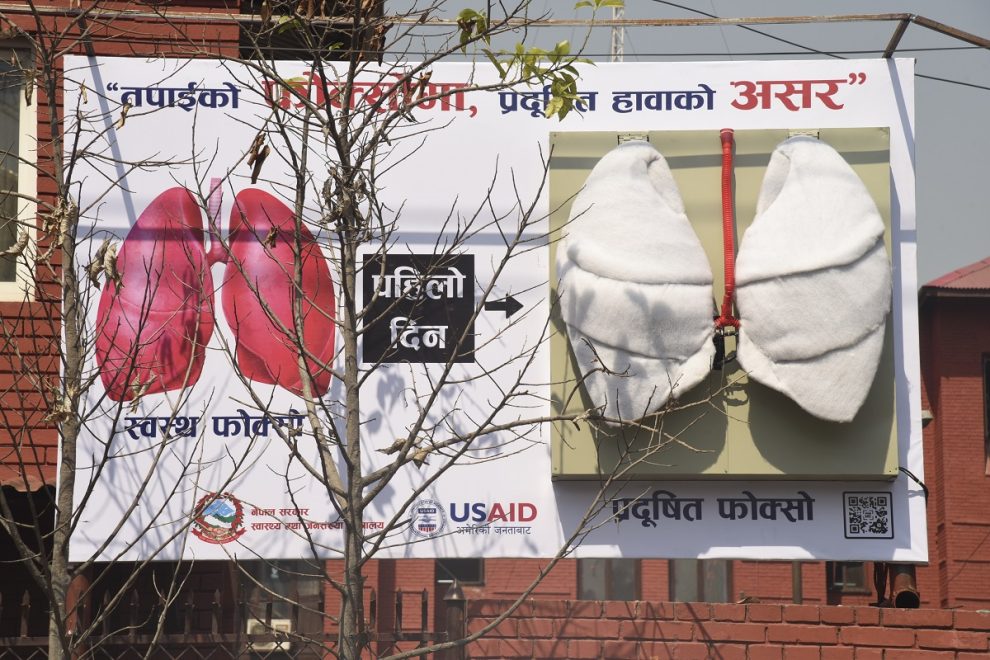
Kathmandu. A pair of artificial lungs has been installed at the entrance of the Ministry of Health and Population for the tangible measurement of air pollution in Kathmandu. On the occasion of World Health Day, the Ministry in collaboration with USAID, Swachh Hawa Project has placed artificial lungs.
This artificial lung has an internal mechanism. This mechanism operates the lungs like human breathing. In a period of 30 days, the effect of air pollution on the color of the lungs will be seen.
This will help to show and explain how air pollution damages human lungs. To explain this, the amount of air pollution in Kathmandu will be shown along with artificial lungs. It will show the real situation to the decision-makers to improve the environment and public health. This will provide evidence for evidence-based policy formulation and implementation processes to address air pollution.
More than 131 countries in the world are dealing with problems related to air pollution. A study by IQ Air, based on Swiss technology, published on March 4, 2022, has shown Nepal in the 16th position among countries with high air pollution. In Nepal in 2019, 42,100 people died due to air pollution. Among them, 5 thousand 80 people died in Kathmandu alone. Chronic obstructive pulmonary disease (COPD) is one of the major causes of death in Nepal. According to the Ministry of Health and Population, 66 percent of deaths are due to air pollution.
Every human activity can be responsible for air pollution. Due to their behavioral activities, it is also affecting those who do not contribute to increasing pollution. The world is now at risk of dying from non-communicable diseases. At this time, there is a need to create a common opinion on air pollution control to make the city suitable for human habitation.




Add Comment